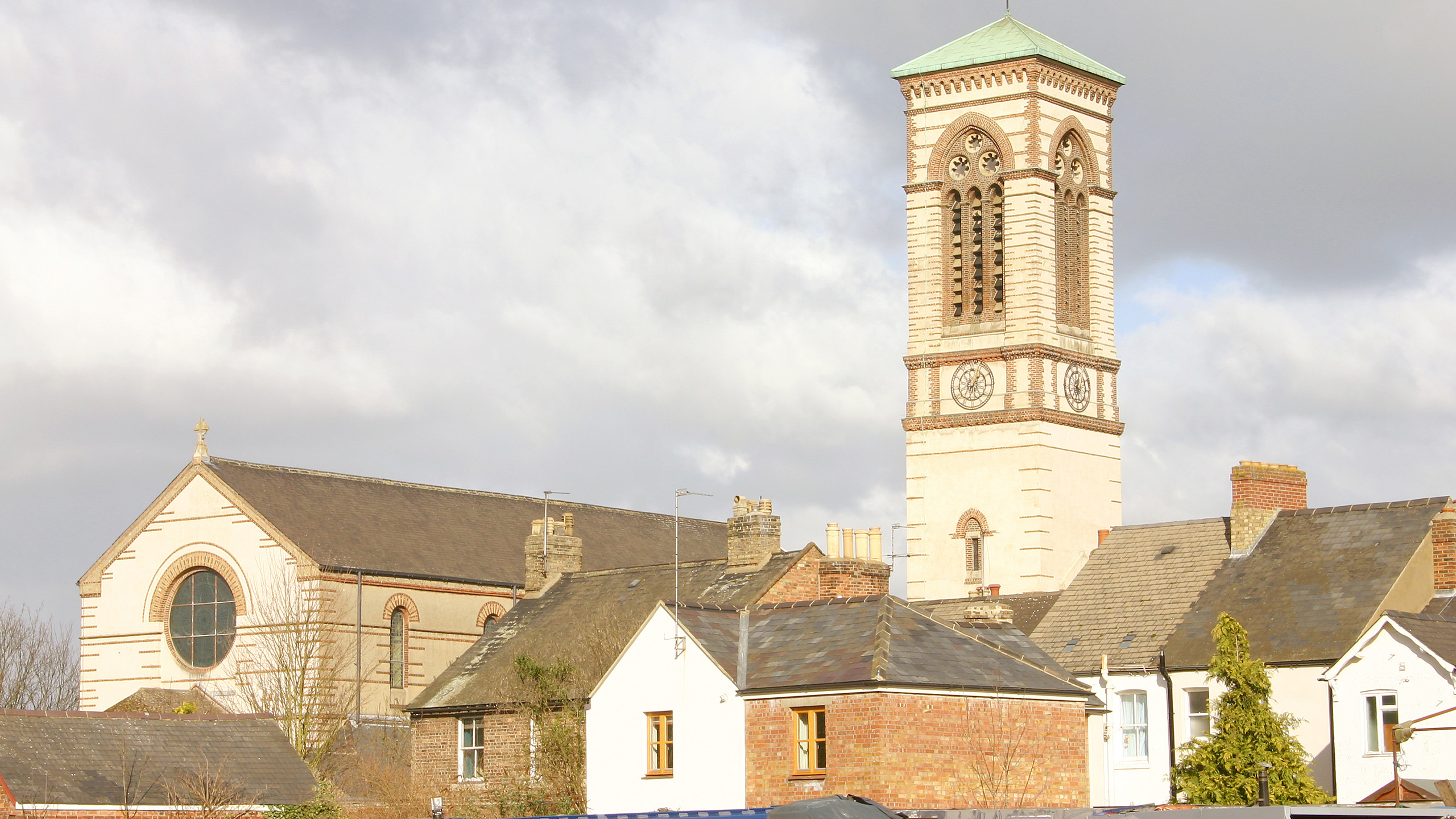
Chiddingstone is a village and civil parish in the Sevenoaks District of Kent, in South East England. It is located on the River Eden, between Tonbridge and Edenbridge, and belongs to the TN8 postcode area. The parish includes not only Chiddingstone itself, but also Chiddingstone Causeway, Bough Beech and the hamlet of Chiddingstone Hoath.
According to the 2011 Census, the parish had a population of 1,250. Administratively, Chiddingstone sits within Kent for police and fire services, while ambulance services are covered by the South East Coast. Its UK Parliament constituency is Tonbridge.
For visitors, Chiddingstone is often known first as a historic village. For residents and local users, however, it is also a working parish with transport links, a school, a village shop, nearby reserves and a long documented history.
Basic Facts About Chiddingstone
Chiddingstone is small, but its parish covers several local settlements. This is useful to understand because many places connected with the village are not all in the same central street.
Key facts to know:
- Village and civil parish: Chiddingstone
- District: Sevenoaks
- County: Kent
- Region: South East England
- Post town: Edenbridge
- Postcode district: TN8
- Nearby river: River Eden
- Nearby towns: Tonbridge and Edenbridge
- Parish settlements: Chiddingstone, Chiddingstone Causeway, Bough Beech and Chiddingstone Hoath
- Population: 1,250 in the 2011 Census
This makes Chiddingstone part of rural Kent, but not an isolated settlement. It sits within reach of larger towns, rail connections and nature reserves.
A One-Street Tudor Village
Chiddingstone is especially noted as an example of a Tudor one-street village. This means the village’s historic form is concentrated around a main street rather than spread across a larger modern layout. Apart from the church and Chiddingstone Castle, the village is owned by the National Trust. This is unusual and helps explain why the village has retained such a consistent historic appearance.
The National Trust acquired the village in 1939. Before that, Chiddingstone had already been shaped by centuries of local ownership, especially by the Streatfeild family, who became major landowners in the area.
Early History
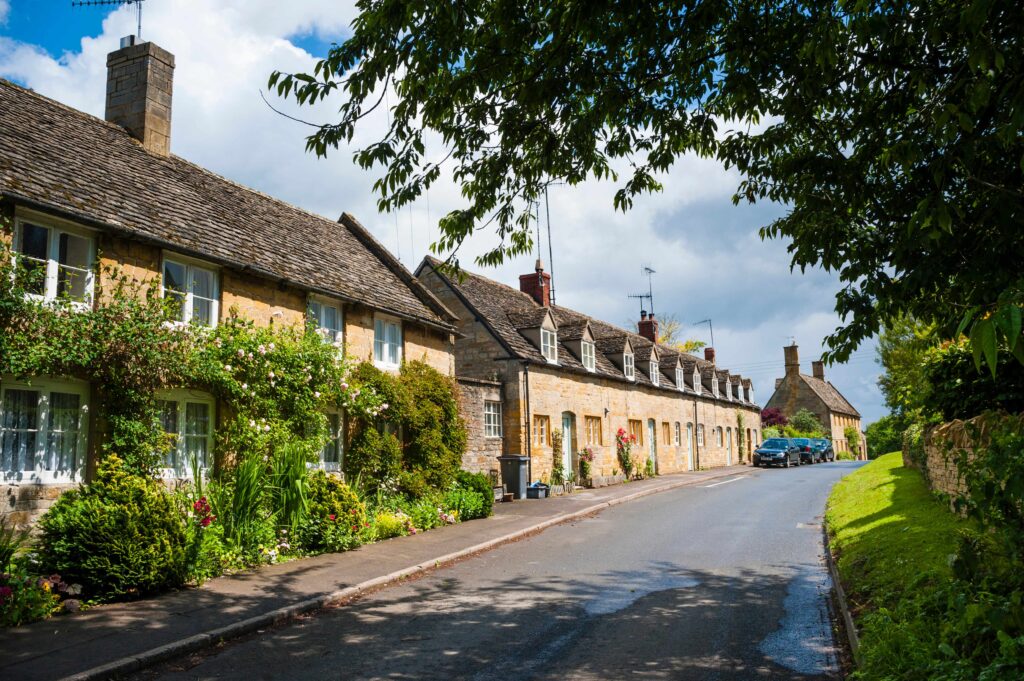
Chiddingstone is recorded in the Domesday Book, which places the village within a much older history than its Tudor appearance might suggest. After the Norman invasion, it was given to Bishop Odo in 1072 as part of his Earldom of Kent.
Another early figure connected with the village is Roger Attwood, whose house is described as being built in a typical Kent style. Several villagers, including Attwood, were involved in Jack Cade’s rebellion of 1450. They were later pardoned.
This gives Chiddingstone a history that includes both landholding and political unrest. It was not only a quiet rural settlement, but also a village touched by the wider conflicts of medieval England.
The Streatfeild Family
The Streatfeild family played a major role in the development of Chiddingstone. Their connection with the area began in 1584, and over time they expanded their landholdings in and around the village.
Chiddingstone Castle became the family seat and remained in their possession from the sixteenth century until the castle was sold to Lord Astor in 1938. The family had already left the castle by 1900.
In the early nineteenth century, Henry Streatfeild made major changes to the village layout. He diverted the road to limit access to his estate, removed some buildings, and developed formal gardens and ponds. He also remodelled the red-brick manor house known as High Street House into Chiddingstone Castle.
This period is important because it shows that Chiddingstone’s historic appearance is not only the result of preservation. It was also shaped by deliberate estate planning and landowner decisions.
Buildings and Local Landmarks
The village has several notable places, but they can be counted briefly here because they are covered more fully elsewhere.
Main sights include:
- The historic main street.
- The Chidding Stone.
- St Mary the Virgin Church.
- Chiddingstone Castle.
- The Castle Inn.
- Bough Beech reservoir.
- Nearby nature reserves.
The Castle Inn is a fifteenth-century building and became a hostelry in 1730. It has literary and artistic associations, with visitors including John Millais, Charles Rennie Mackintosh and Arthur Rackham.
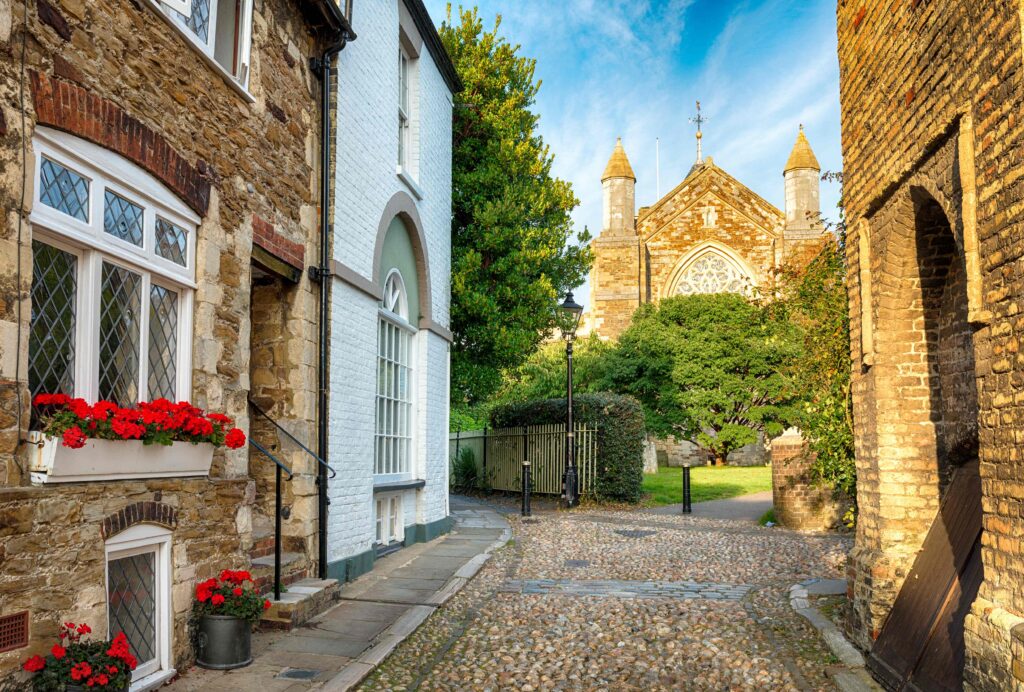
St Mary the Virgin is the parish church and may be the fourth church built on its site. A stone gazebo in the churchyard dates from 1736 and was built by Henry Streatfeild. It leads down to the Streatfeild family vault, which has ventilation through false altar tombs.
The church was almost destroyed by a lightning fire in 1624. More recent additions include a chapel built at the base of the tower in 1979 and an adjoining lavatory added in 2007.
The Name Chiddingstone
The origin of the name Chiddingstone is linked to more than one explanation. One popular theory connects it with the Chiding Stone, a large sandstone formation on the outskirts of the village.
Another explanation, preferred by the National Trust, connects the name with “Chidding tun,” meaning the homestead of Cidda’s family. The village was recorded as “Cidingstane” in the twelfth century.
The stone itself has several traditional interpretations. It may have been used as a place for public reprimand, as a ritual site, or as an Anglo-Saxon boundary marker. These explanations are not identical, but they all show how strongly the name of the village is tied to landscape, memory and local tradition.
Village Life Today
Chiddingstone is small, but it has practical local features. The nearest railway station is Penshurst railway station, located in Chiddingstone Causeway. It is on the line between Tonbridge and Redhill. The parish also has Chiddingstone Church of England School, a primary school. For everyday use and visitors, the village has a shop and café called The Tulip Tree, which is especially popular with cyclists at weekends.
There are several nature reserves in the area, including Chiddingstone Reserve and reserves operated by Kent Wildlife Trust. These add another side to the parish, beyond historic buildings and village streets.
Chiddingstone on Screen
Chiddingstone has also been used as a filming location. It appeared in the 1985 Merchant Ivory film A Room with a View, in a scene involving Lucy and Cecil after their engagement party. The High Street is visible from the end closest to the Castle Inn.
Other productions connected with the village include The Wicked Lady, Wind in the Willows – Mr Toad’s Wild Ride, Elizabeth R with Glenda Jackson, and Gerald Scarfe’s Life of Hogarth. Chiddingstone’s preserved street layout, old buildings and controlled village appearance make it suitable for period productions.
Visit Chiddingstone!
Chiddingstone is a small Kent parish with a long historical record, a distinctive ownership structure and a preserved village centre. Its importance comes from several connected facts: its Domesday history, its one-street Tudor form, its association with the Streatfeild family, its National Trust ownership and its role as both a local community and a visitor destination.
It is a place shaped by medieval records, estate management, religious history, transport links, conservation, education, nature reserves and film use. For that reason, Chiddingstone is best understood as a compact village with a surprisingly wide historical and cultural footprint.